After the Grenfell Tower fire in June 2017, the fire performance of external wall systems, cladding, insulation, fire breaks and balconies came under far closer scrutiny across the UK residential property market.
The External Wall System review process and EWS1 form were developed by the Royal Institution of Chartered Surveyors (RICS), UK Finance and the Building Societies Association (BSA) to give lenders and valuers a consistent way to record whether a building's external wall system has been assessed by a suitable professional.
An EWS1 survey in Sutton Coldfield considers the external wall system of a residential building or block and records the outcome on an EWS1 form. The form is used for valuation and lending purposes; it is not a government certificate, a legal requirement or a substitute for a fire risk assessment.
The cost and time needed for an EWS1 survey depends on the height, design and complexity of the building, the information already available, and whether intrusive investigation or material testing is needed.
The person signing an EWS1 form must have the right competence, experience, professional standing and insurance for the option being completed.

An EWS1 form is intended to record, in a consistent format, what review has been carried out on the external wall construction of a residential building.
It applies to the whole building or block, not to one flat. Where a form is needed, a qualified and competent professional reviews the external wall system and signs the relevant option on the EWS1 form.
A completed EWS1 form is normally valid for five years for that building, although lenders, building owners or new information about the external wall system may lead to a further review.
Not every block requires an EWS1 form. RICS guidance expects valuers to have a clear reason for requesting one, taking account of height, cladding type, extent of cladding, balconies and other external wall risks. A second edition of the RICS secured lending valuation standard was published in May 2026 and is effective from 1 November 2026.
EWS1 surveys in Sutton Coldfield may be relevant for:
Multi-storey, multi-occupied residential buildings where the external wall system may affect lending or valuation
Buildings with combustible cladding, unknown wall build-ups, or attachments such as balconies that may need review
Buildings where a lender, valuer, owner or managing agent needs a clear external wall review outcome
An EWS1 form is usually requested as part of a sale, purchase or remortgage when a valuer or lender needs more confidence about the external wall system. It is not automatically required for every flat, every building, or every building below a certain height.
For a specific building, the decision normally depends on the building height, the external wall materials, the amount and type of cladding, balcony construction, and the lender's own policy. Government has also encouraged lenders to move away from relying on EWS1 forms where a suitable Fire Risk Appraisal of External Walls is available.
PAS 9980:2022 is the code of practice used for fire risk appraisals of external walls, often referred to as FRAEW. A PAS 9980 appraisal considers the fire risk of the external wall construction in more detail than the front-page lending outcome recorded on an EWS1 form.
In practice, a building owner, managing agent, lender or valuer may ask whether an EWS1 form, a PAS 9980 FRAEW, or both are appropriate. The right route depends on the building, the available evidence and the reason the review is being requested.
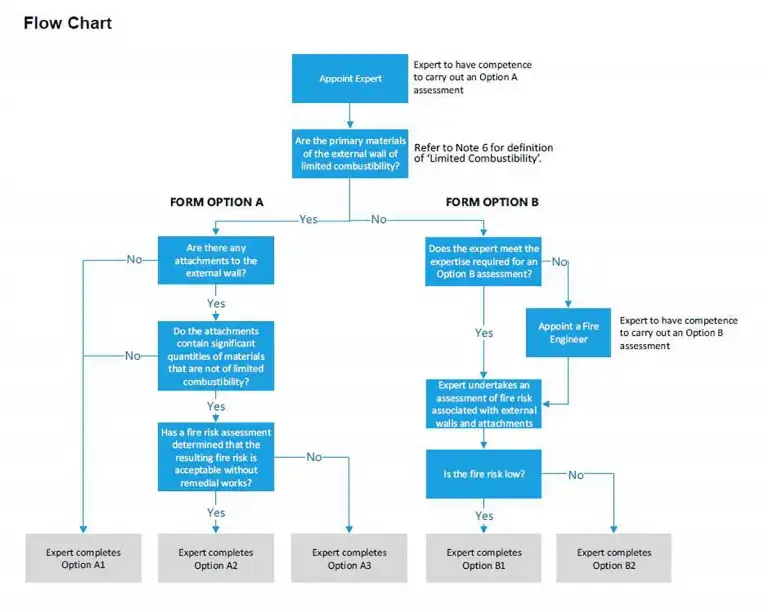
Option A is used where the external wall materials are unlikely to support combustion. Option B is used where combustible materials are present in the external wall system.
Under Option B, a B1 outcome means the fire risk is sufficiently low that remedial works are not required for the lending purpose. A B2 outcome means remedial works are required. Lenders make their own decisions about how they treat each outcome.
The EWS1 process in Sutton Coldfield is now part of a wider building safety landscape that includes PAS 9980 fire risk appraisals of external walls (FRAEW), lender policy and RICS valuation guidance.
Typical steps include:
The assessor reviews the available building information and, where needed, visits the site to inspect the external wall system.
The review can include the outer wall coverings, cladding, insulation, cavity barriers, fire stopping and balconies. If records are incomplete, intrusive opening-up or testing may be required to confirm the construction.
The professional completes the EWS1 form with the relevant option. Option A is used where external wall materials are unlikely to support combustion; Option B is used where combustible materials are present, with B1 or B2 showing whether remedial works are required for lending purposes.
We connect property owners, property managers, surveyors and developers with qualified surveyors and fire engineers for EWS1 External Wall Fire Review work.
These professionals can help establish whether an EWS1 form, PAS 9980 FRAEW or related external wall review is appropriate for the building, and can support clients through the information-gathering, inspection and reporting stages.
Request a free quote with your requirements today.